
Interfaces
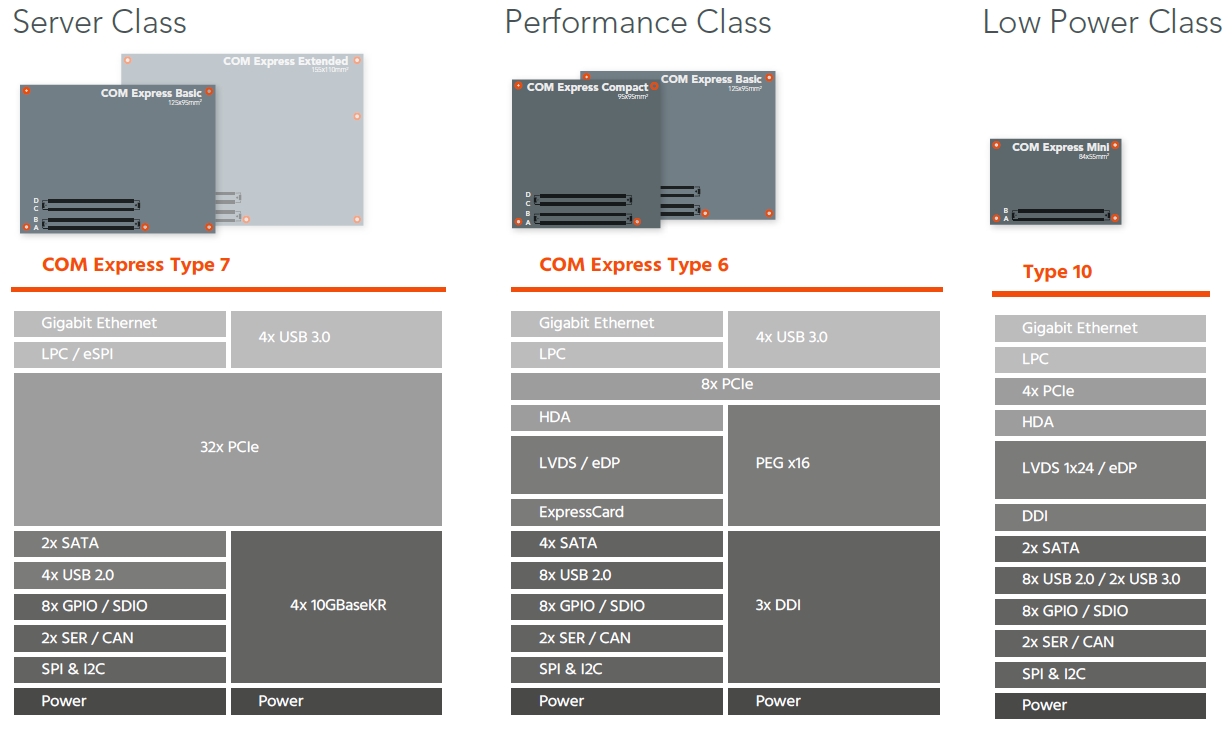
COM Express connects modules and carrier boards through standardized connectors with up to 440 pins. Revision 3.1 supports PCIe Gen 4 and, depending on the pinout, interfaces such as USB4, SATA and digital displays.

Simplify embedded development with a proven industry standard
Discover the COM Express standard with scalable performance, standardized interfaces, and flexible form factors for embedded and edge computing applications.
COM Express® is a widely adopted Computer-on-Module (COM) standard defined by the PICMG® consortium. It specifies standardized form factors and interfaces, providing a flexible and scalable foundation for high-performance embedded and edge computing applications. The current COM Express Revision 3.1 supports modern interfaces such as PCI Express® Gen 4, optional USB4 for Type 6, SATA, and high-resolution display connectivity. With Type 6 for graphics-intensive applications, Type 7 for headless embedded servers, and Type 10 for compact, low-power systems, COM Express addresses a broad range of industrial requirements.
COM Express connects modules and carrier boards through standardized connectors with up to 440 pins. Revision 3.1 supports PCIe Gen 4 and, depending on the pinout, interfaces such as USB4, SATA and digital displays.
COM Express Type 7 is designed for headless server and networking applications, supporting up to four 10GbE interfaces and 32 PCIe lanes.
Standardized COM Express modules combine with application-specific carrier boards, allowing developers to integrate custom I/O and system functions.
Four standardized sizes are defined: Mini (84 × 55 mm), Compact (95 × 95 mm), Basic (125 × 95 mm) and Extended (155 × 110 mm).
COM Express provides eight general-purpose input/output signals for application-specific control and system integration.
Thermal interfaces and cooling solutions are adapted to the module's power requirements and the application's operating conditions.
COM Express Rev. 3.1 supports PCIe Gen 4 with signaling rates up to 16 GT/s per lane. The available lane count depends on the module type.
Type 6 supports multiple display interfaces, including digital display outputs and LVDS or eDP options. Type 7 is designed for headless operation without dedicated display outputs.
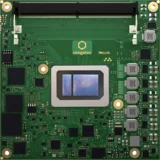

conga-TC300
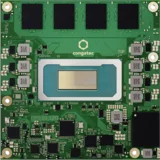
conga-TC1000r
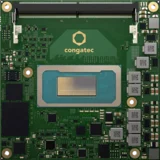
conga-TC1000
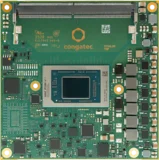
conga-TCRP1
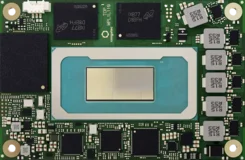
conga-MC1000
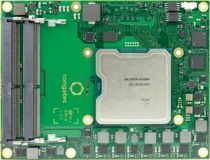
conga-B7XI