

- エコシステム
- クイック ファインダー









Intel® Core™ Series 3
Computer-on-Modules for cost- and energy-efficient edge AI computing
COM-Express Compact Module with Intel® Core™ Series 3 processors
Dedicated AI acceleration for energy-efficient embedded and industrial edge AI applications.
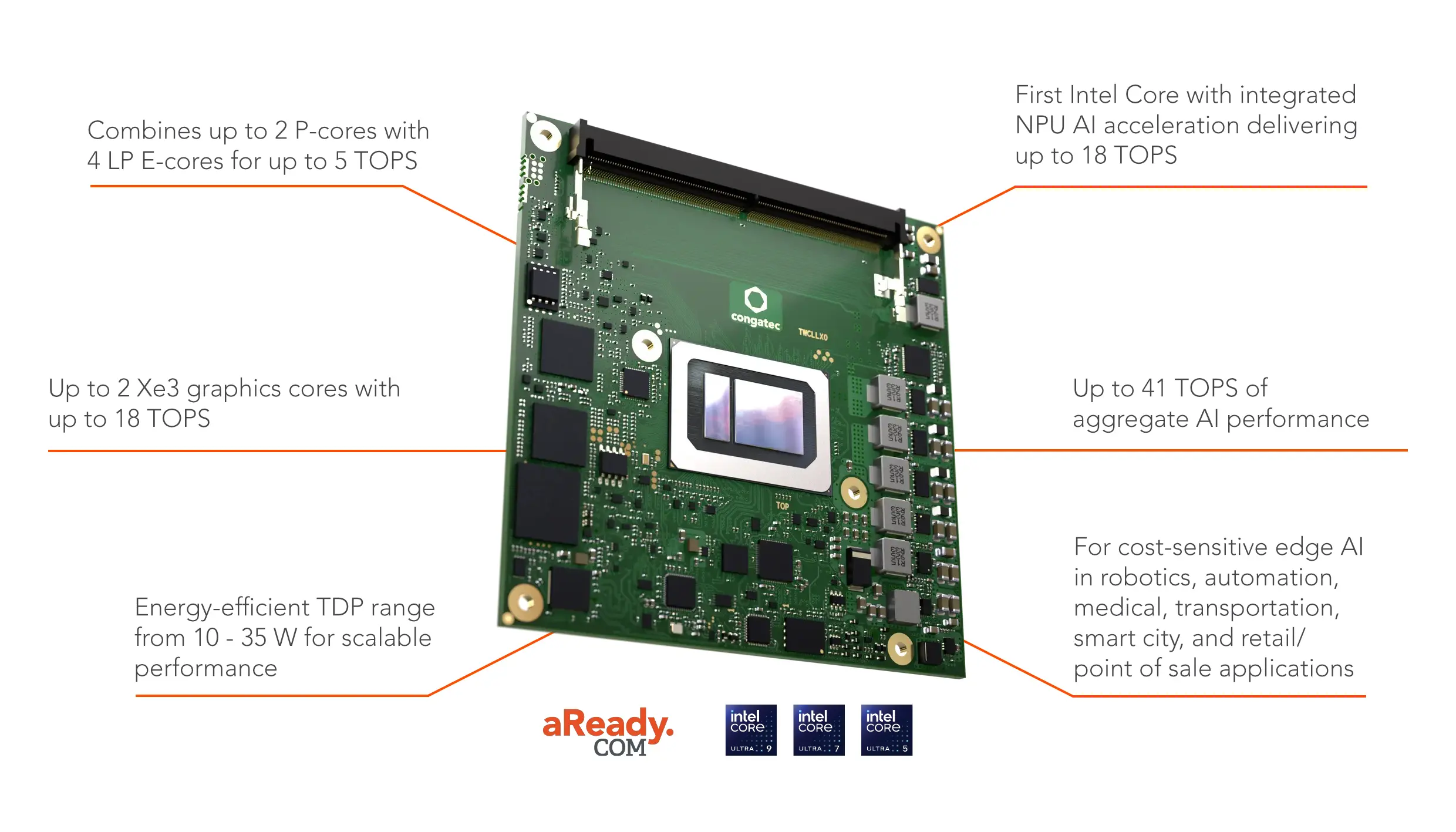
Intel® Core™ Series 3 processors – Codename: Wildcat Lake – are bringing latest processor technologies Intel introduced with the Intel Core Ultra series 3 processors now also to the low-power and entry-level segments of x86-based embedded computing. First of all, they feature up to 2 Performance-cores (P-cores) and 4 Low-Power Efficient-cores (LP E-cores) built on Intel’s groundbreaking 18A process technology for a significant gain in performance and computing density. Next, they are the first Intel Core processor to include a dedicated neural processing unit (NPU). Furthermore, this highly integrated system-on-chip (SoC) also includes the Intel® Xe3 graphics accelerating AI applications for General Purpose GPU (GPGPU) within a configurable 10 to 35 W power envelope.
Implemented on the application-ready conga-TC300 COM Express Compact module, the new processor generation provides developers with a cost-efficient platform for adding local AI capabilities to industrial automation, robotics, medical, transportation, smart city, and retail systems.
An efficient upgrade path to edge AI
Intel® Core™ Series 3 processors provide a practical migration path for embedded applications that are based on legacy Intel Atom® or Celeron® processor platforms, bringing now dedicated AI acceleration into low power x86 platforms. The heterogeneous processor architecture integrates up to two Performance-cores (P-cores) and four Low-Power Efficient-cores (LP E-cores). With this up to 6-core architecture, the CPU delivers up to 5 TOPS.
The Intel® Core™ Series 3 processors are equipped with a dedicated NPU that provides up to 18 TOPS for energy-efficient AI inference. This NPU is optimized for continuously running AI workloads such as object detection, image classification, anomaly detection, and speech and gesture recognition.
Up to two Intel® Xe3 graphics cores contribute a further 18 TOPS. In addition to driving graphical user interfaces and multiple displays, the integrated graphics cores accelerate highly parallel workloads such as image preprocessing, computer vision, and GPGPU-based AI processing.
By combining the CPU, Intel® Xe3 graphics, and the dedicated NPU, the conga-TC300 delivers up to 41 TOPS of aggregate AI performance. The module provides a reliable migration path to new AI capabilities for low-power and lightweight AI applications, backed by a planned availability of up to ten years.
OEMs can use the conga-TC300 to add AI functionality to existing applications by a simple module exchange. OEMs do not have to re-design the hardware but simply upgrade their applications such as automated guided vehicles (AGVs), autonomous mobile robots (AMRs), intelligent machine controls, HMIs, patient data monitoring systems (PDMS), surveillance systems, and check-in or check-out terminals by software.
Potential AI use cases include local voice and gesture control, AI-assisted object recognition and identification, and dialogue functions based on large language models (LLMs). This makes the conga-TC300 a suitable platform for developers seeking to increase the value of their existing designs by adding cost- and energy-efficient AI performance
Designed for cost-sensitive and power-constrained systems
With a base TDP of 15 W and a configurable power range from 10 to 35 W, Intel® Core™ Series 3 processors enable developers to balance compute performance, AI acceleration, and thermal requirements for different product variants. The integrated architecture reduces the need for additional accelerator hardware. This can lower system complexity, power consumption, cooling requirements, carrier board space, and bill-of-materials (BOM) costs.
The conga-TC300 module makes Intel® Core™ Series 3 processor technology available in the standardized COM Express Compact form factor. OEMs can integrate the module into application-specific carrier boards while retaining a modular and scalable system architecture. This approach is particularly well suited for product families that require different performance levels but benefit from sharing the same carrier board design, software environment, and I/O concept
Facts, Features & Benefits
| Facts | Features | Benefits |
|---|---|---|
| Heterogeneous compute architecture | 2 Performance-cores, 4 Low-Power Efficient-cores, Intel® Xe3 graphics, and a dedicated NPU integrated into a single SoC | Always leverage the ideal processing unit to efficiently consolidate application processing, graphics and AI inference on one platform to increase the functionality and performance of existing applications and reduce the need for discrete accelerator hardware |
| Hybrid CPU architecture | 6 CPU cores comprising 2 P-cores and 4 LP E-cores, with P-core turbo frequencies of up to 4.8 GHz | Provides responsive single-thread performance and efficient background processing for control, communication, and embedded application workloads. |
| Integrated Intel® Xe3 graphics | Up to 2 graphics cores with up to 18 TOPS of AI acceleration | Accelerates graphical user interfaces, image preprocessing, computer vision, and parallel GPGPU workloads without requiring a discrete GPU. |
| Dedicated NPU | Up to 18 TOPS of AI processing performance | Executes continuous AI workloads with high energy efficiency and reduces the processing load on the CPU and graphics cores. |
| High-speed system memory and integrated mass storage | Up to 64 GB DDR5 memory at up to 6400 MT/s, with optional in-band ECC (IBECC). Optional onboard UFS 3.1 storage with capacities of up to 512 GB | Supports data-intensive embedded and AI workloads while optional error correction improves system integrity. Reduces the need for external storage devices and simplifies compact system designs. |
| Industrial networking capabilities | Optionally up to 8 freely configurable PCIe lanes, 2.5 Gigabit Ethernet with optional Time-Sensitive Networking (TSN), and Time-Coordinated Computing (TCC) support | The freely configurable PCIe lanes support Ethernet controllers, field bus adapters, wireless modules, and other low-lane peripherals without requiring an additional PCIe switch on the carrier board. Gigabit Ethernet enables deterministic and time-aware communication for industrial automation, robotics, and real-time edge applications. |
| Configurable processor power | 10 to 35 W configurable power range with 15 W processor base power | Allows developers to optimize performance and cooling for fanless, actively cooled, and application-specific system designs. |
| Extensive display and peripheral interfaces | Up to 2x DDI, 1x LVDS or eDP, up to 2x USB4, 4x USB 3.2, 4x USB 2.0, 2x SATA, 2x UART, GPIOs, GP SPI, eSPI, SM Bus, HDA, and I2C interfaces | Simplifies the implementation of industrial HMIs, medical displays, operator terminals, and connected edge devices. |
Typical Applications

Robotics
Automated guided vehicles (AGVs), autonomous mobile robots (AMRs), and service robots require a combination of navigation, perception, communication, and control capabilities. Intel® Core™ Series 3 processors provide dedicated resources for processing sensor data, detecting and identifying objects, interpreting voice or gesture commands, and operating graphical user interfaces.

Industrial Automation
Machine controllers or vision and quality inspection systems can execute control logic, image preprocessing, and AI inference on one compact platform. The CPU handles application and control workloads, while the graphics cores accelerate image processing. The NPU efficiently executes AI models for defect detection, optical character recognition, or predictive maintenance

Medical Technology
Patient data monitoring systems, diagnostic devices, and medical user interfaces can use local AI to analyze data and support clinical workflows without continuously transferring sensitive information to the cloud. The integrated NPU enables energy-efficient inference, while the CPU and graphics cores provide the performance required for application processing, visualization, and connected device functions.

Transportation
Passenger information systems, fleet terminals, vehicle gateways, and monitoring systems can combine graphics, connectivity, and AI processing on a single module. Potential functions include driver or passenger interaction, object recognition, voice control, condition monitoring, and local analysis of camera or sensor data.

Smart City
Connected cameras, access control systems, and intelligent infrastructure can process video and sensor data directly at the edge. The dedicated NPU supports continuous inference workloads, while Xe3 graphics accelerates image preprocessing and computer vision pipelines. Local processing reduces network traffic, shortens response times, and allows systems to retain greater control over sensitive operational data.

Retail/Point-of-Sale
Self-service terminals, check-in and checkout systems, digital kiosks, and smart vending machines can add functions such as object identification, voice interaction, gesture control, and LLM-based dialogue. The combination of AI acceleration, graphics, display interfaces, and integrated connectivity enables compact and responsive systems without requiring discrete AI accelerators.
Further relevant media
Everything you need to know about COMs
Computer-on-Modules (COMs) power everything from robotics and medical devices to edge computing and smart mobility. But what makes them so versatile? And which standard is right for your needs? Explore the answers in our comprehensive guide to COMs.