
- エコシステム
- クイック ファインダー








Industrial PCs - Two operating systems on one device?
Harness the power of today’s multicore processors
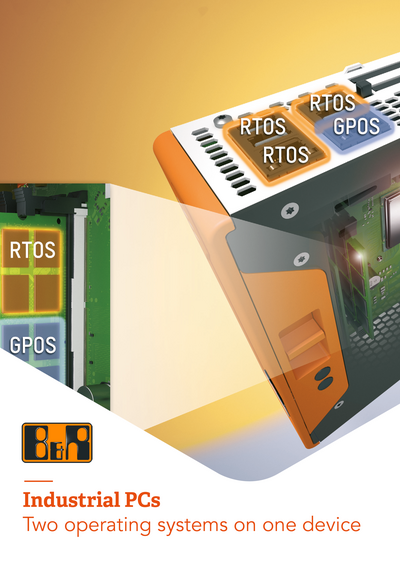
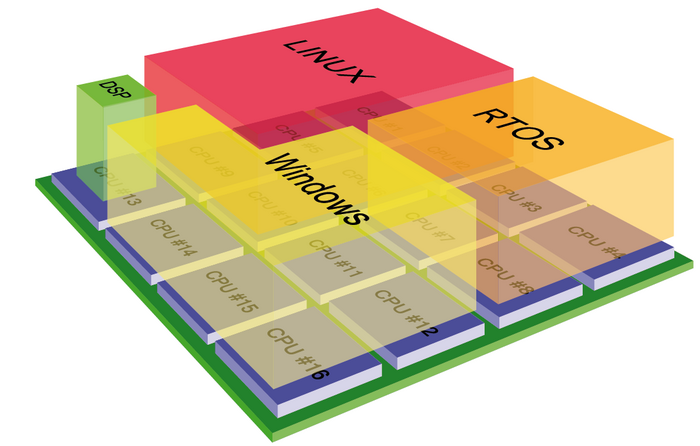
In addition to their real-time operating system, many machines also need a general purpose operating system to perform tasks such as aggregating data and sending it to the cloud, or to run business intelligence analytics or computationally intensive HMI applications. Traditionally, this has required the use of two separate pieces of hardware. With a bare-metal hypervisor, it is now possible to implement both systems on a single industrial PC without any compromise in performance.
Modern controllers and real-time operating systems offer extremely high performance and are able to perform a multitude of functions. Nevertheless, it is often advantageous to run additional functions and software applications on a separate operating system. "Specialized programs for simulation or 3D animations are often run on a Linux or Windows system," explains Gerd Lammers, president of Real-Time Systems. Web applications also often run in Linux or Windows environments rather than on real-time systems.
The RTS hypervisor allows all of the hardware resources of an industrial PC to be allocated unambiguously.
Do you want to learn more about the advantages of our real time hypervisor and how you can use it in your application?
Download our Whitepaper
The innovative Real-Time Systems Hypervisor permits multiple operating systems - both real-time (RTOS) and general purpose operating systems (GPOS) like Microsoft™ Windows® or Linux - to run concurrently on multicore x86 processors. By utilizing this powerful and cost-effective software solution, designers achieve increased flexibility in system design and remarkable enhancements to functionality and performance - at the same time reducing overall system cost.
Hard Real-Time Performance: Multiple Operating Systems in Perfect Harmony
- Combine real-time operating systems like VxWorks®, QNX Neutrino or Real-Time Linux , with e.g. Microsoft™ Windows®
- Operating systems reside simultaneously on an x86 computer while maintaining the hard real-time characteristics of an RTOS
- Reboot any operating system anytime without disturbing the execution of other operating systems
- Communication via high performance virtual TCP/IP network and flexible shared memory
- User-definable boot sequence