










AMD Ryzen™ AI Embedded X100 Series
Computer-on-Modules for powerful physical AI at the edge
COM-HPC Client Size C Module with AMD Ryzen™ AI Embedded X100 Series Processors
Maximum edge and physical AI performance through the integration of high-performance CPU, GPU, and NPU architectures.
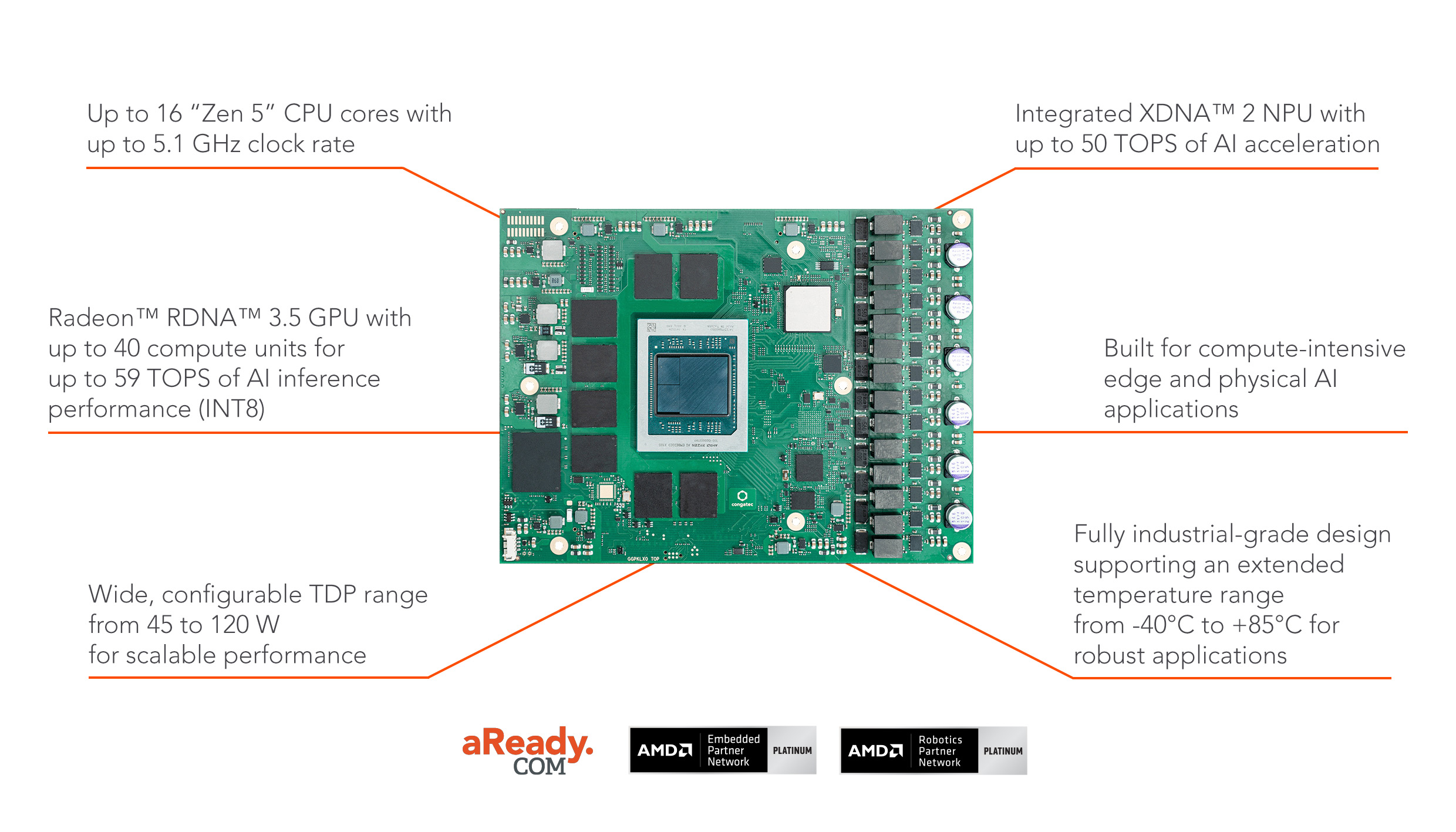
The AMD Ryzen™ AI Embedded X100 Series processors define a new performance class for scalable embedded and edge computing. They combine up to 16 AMD “Zen 5” CPU cores, an integrated Radeon™ RDNA™ 3.5 iGPU, and a dedicated XDNA™ 2 NPU delivering up to 50 TOPS of AI acceleration within a System-on-Chip (SoC) with high compute density. Highly integrated AI and FP32 compute performance eliminate the need for discrete AI accelerator cards in many target applications.
Scalable Performance for Physical AI at the Edge
The AMD Ryzen™ AI Embedded X100 Series processors are part of the AMD Kria™ AI SOM portfolio and have been specifically designed to address the growing performance requirements of modern physical AI applications. They combine powerful CPU, GPU, and NPU resources within a high-performance SoC, enabling deterministic AI performance directly at the edge. As a result, there is no need for discrete graphics cards, additional AI hardware accelerators, or cloud processing.
The new AMD Ryzen™ AI Embedded X100 Series features up to 16 AMD “Zen 5” CPU cores alongside an integrated AMD Radeon™ RDNA™ 3.5 GPU that delivers up to 59 TOPS of AI inference performance and up to 29.7 TFLOPS of FP32 compute performance. With a dedicated AMD XDNA™ 2 NPU providing up to 50 TOPS of additional AI performance, these SoCs provide a highly scalable platform for a broad range of AI workloads. They are particularly suited for demanding physical AI applications in robotics, industrial automation, medical technology, autonomous commercial vehicles, and smart infrastructure.
Built on AMD's advanced “Zen 5” architecture using 4 nm process technology, the SoCs deliver exceptional CPU compute performance for time-critical and sequential workloads such as real-time control, sensor fusion, and decision-making. The integrated RDNA™ 3.5 GPU is ideally suited for highly parallel workloads such as image pre-processing, perception and object recognition in collaborative robots and autonomous vehicles, simultaneous localization and mapping (SLAM), and the local execution of large language models (LLMs). The XDNA™ 2 NPU complements the architecture with a highly efficient AI accelerator optimized for always-on AI applications such as object detection, speech processing, image classification, and anomaly detection.
A key advantage for generative AI applications is the unified memory architecture. The CPU and GPU share the same high-speed memory pool, allowing scaled memory allocation to the GPU based on the application. With up to 128 GB of LPDDR5x memory, as much as 96 GB can be made available for GPU-driven workloads, enabling large LLMs to run locally without requiring discrete graphics cards equipped with dedicated memory.
For Scalable High-Performance Physical AI Systems
With a widely configurable TDP range from 45 to 120 W, the new SoCs enable flexible embedded compute optimization for a broad variety of performance and cooling concepts – from edge applications optimized for low power consumption to compute-intensive physical AI platforms. Developers additionally benefit from the scalable COM architecture, which allows underlying hardware design to be preserved across related modules with different performance levels.
The high level of performance provided by the AMD Ryzen™ AI Embedded X100 Series processors eliminates the need for discrete graphics or dedicated AI accelerator cards in many applications. This simultaneously reduces system complexity, power consumption, cooling requirements, and bill of materials (BOM) costs. At the same time, a design with fewer critical components improves overall application reliability and robustness.
Facts, Features & Benefits
| Facts | Features | Benefits |
|---|---|---|
| Heterogeneous High-Performance Architecture | Up to 16 AMD “Zen 5” CPU cores, AMD Radeon™ RDNA™ 3.5 GPU, and AMD XDNA™ 2 NPU, integrated into a single SoC. | Consolidates real-time control, AI inference, and highly parallel data processing on a single platform while eliminating the need for discrete graphics cards or AI accelerators. |
| Powerful Zen 5 CPU Cores | Up to 16 CPU cores with clock speeds of up to 5.1 GHz | Delivers outstanding single- and multi-core performance for real-time control, sensor fusion, decision-making, and communication workloads. |
| Integrated RDNA™ 3.5 GPU (iGPU) | Up to 59 TOPS of AI inference (INT8) and up to 29.7 TFLOPS FP32 compute performance | High-performance general-purpose GPU (GPGPU) for highly parallel workloads and the local execution of LLMs, combined with immersive graphics across up to four independent displays for demanding gaming, AV, and industrial multi-display applications. |
| XDNA™ 2 NPU | Up to 50 TOPS AI processing performance | Enables AI inference with low power consumption and accelerates physical AI applications such as robotics, machine vision, autonomous vehicles, and intelligent medical devices with outstanding energy efficiency. |
| Unified Memory Architecture | Up to 128 GB LPDDR5x-8533 memory with shared access for CPU, GPU, and NPU and up to 96 GB allocatable to the integrated GPU | Enables highly efficient data sharing between CPU, GPU, and NPU, minimizes data transfer latency, and significantly improves the performance of memory-intensive AI and GPGPU workloads. The large GPU memory allocation also enables local execution of large LLMs and multimodal AI models without requiring discrete AI accelerators. |
| Industrial-grade Robustness | Industrial temperature range from -40°C to +85°C, soldered memory, and long-term availability | Designed for reliable operation in harsh industrial, transportation, and outdoor environments while improving thermal resilience and increasing mean time between failures (MTBF), reducing maintenance requirements and total cost of ownership (TCO). Long-term availability further extends overall system lifetime. |
| Programmable Power Configuration | Scalable TDP range from 45 to 120 W with a base TDP of 55 W | Supports different performance levels while simplifying thermal design across multiple products sharing a common hardware basis. |
| Extensive I/O | Up to 24 PCIe Gen4 lanes | The many PCIe lanes are ideal for I/O-intensive applications requiring numerous peripheral devices. Industrial Ethernet interfaces, fieldbus adapters, wireless communication modules, and other low-lane devices can be integrated with ease. Additional interfaces include 2x 2.5GbE, up to 4x USB 3.2 Gen2, up to 8x USB 2.0, up to 2x SATA 6 Gb/s, 2x I²C, 2x UART, 12x GPIO, 1x SMBus, and 1x GPSPI. |
Typical application areas

Physical AI
The AMD Ryzen™ AI Embedded X100 Series accelerates perception, decision-making, and actuation for physical AI applications. The CPU cores handle sensor fusion and real-time actuator control, the GPGPU performs image processing, and the NPU executes AI inference efficiently and with low latency.

Autonomous commercial Vehicles
Autonomous commercial vehicles used in smart farming, logistics, or forestry benefit from deterministic AI inference, sensor fusion, and high compute performance directly on board the vehicle. The industrial temperature range ensures reliable operation even under the most demanding environmental conditions.

Industrial Automation
Applications such as machine vision systems, automated quality inspection, optical character recognition (OCR), and predictive maintenance require the processing of large volumes of data with minimal latency. The heterogeneous processor architecture accelerates image pre-processing, AI inference, and real-time control on a single computing platform.

Medical Technology
Powerful GPU and NPU acceleration enable local processing of medical imaging data for ultrasound, endoscopy, and other imaging systems. AI-assisted diagnostics can be performed directly on the device, supporting clinicians with real-time decision-making at the point of care.

Robotics
The combination of CPU, GPU, and NPU accelerates image processing, sensor fusion, and motion planning to enable precise real-time decisions for collaborative robots (cobots), autonomous mobile robots (AMRs), and many other robotics platforms in Industry 5.0.

Smart Infrastructure
From intelligent traffic monitoring to video analytics in critical infrastructure, local AI processing delivers fast response times, enhanced data security, and reliable operation without dependence on cloud infrastructure.
FAQs
Can I eliminate a discrete AI accelerator card when using the AMD Ryzen AI Embedded X100 Series?
In many target applications, yes. The integrated AI and FP32 compute performance of the AMD Ryzen AI Embedded X100 Series is sufficient to eliminate the need for discrete graphics or AI accelerator cards across a wide range of use cases. This reduces system complexity, power consumption, thermal management effort, and bill-of-materials cost.
How do the CPU, GPU, and NPU share compute tasks in a physical AI application?
The three compute engines handle clearly defined tasks: CPU cores manage time-critical, sequential workloads such as real-time control, sensor fusion, and decision-making. The integrated GPU accelerates highly parallel tasks including image preprocessing, perception, object detection, and SLAM. The NPU handles efficient always-on AI workloads such as object recognition, speech recognition, and anomaly detection.
Which application areas are best suited for the X100 Series?
The processors address a broad range of physical AI applications: robotics, autonomous utility vehicles (smart farming, logistics, forestry), industrial automation (machine vision, quality control, predictive maintenance), medical technology (imaging systems, AI-assisted diagnostics), and smart infrastructure such as traffic monitoring and video analytics.
How much system memory can be allocated to the GPU for local LLM execution?
Thanks to its unified memory architecture, the CPU and GPU share the same high-speed memory pool. Of up to 128 GB LPDDR5x-8533, as much as 96 GB can be allocated to the GPU — sufficient to run even large LLMs locally, without requiring discrete graphics cards with dedicated memory.
What makes modules based on the AMD Ryzen AI Embedded X100 Series especially well-suited for physical AI?
The module consolidates the compute resources required for perception, intelligence, and actuation on a single platform. Its integrated CPU, GPU, and NPU architecture enables diverse workloads to be processed directly at the edge, eliminating the need for continuous data transfer to the cloud.
Is the module suited for operation in harsh industrial or outdoor environments?
Yes. The modules support an industrial temperature range of -40 °C to +85 °C, feature soldered memory for shock and vibration resistance, and offer long-term availability — key requirements for vehicle, industrial, and outdoor applications.
What TDP range do the modules support, and how does this affect thermal design and system architecture?
The modules have a base TDP of 55 W and are configurable across a range of 45 to 120 W. This allows the same hardware platform to be flexibly deployed across different performance classes — from power-optimized edge systems to compute-intensive physical AI platforms.
How many PCIe lanes and additional interfaces are available for peripheral connectivity?
Up to 24 PCIe Gen4 lanes are available for expansion, making the modules ideal for I/O-intensive applications with numerous peripherals. Additional interfaces include 2x 2.5 GbE, up to 4x USB 3.2 Gen 2, up to 8x USB 2.0, up to 2x SATA 6 Gb/s, 2x I²C, 2x UART, 12x GPIO, 1x SMBus, and 1x SPI.
Which operating systems are supported, and are preconfigured software solutions available?
Supported operating systems include Microsoft Windows 11, Windows 11 IoT Enterprise, and Linux. As application-ready aReady.COMs, the modules are also available with licensed and configured operating systems such as ctrlX OS, Ubuntu Pro, and KontronOS.
How does the module support cybersecurity requirements, including those of the Cyber Resilience Act?
The modules were developed in accordance with IEC 62443-4-1 and feature integrated security through a Trusted Platform Module (TPM 2.0). This helps OEMs meet cybersecurity requirements and prepares them for the EU Cyber Resilience Act, which takes effect in December 2027.
Can multiple workloads such as real-time control, HMI, and AI be consolidated on a single module?
Yes, with the aReady.VT option. The integrated conga-zones hypervisor enables multiple workloads — including real-time control, HMI, AI, and IoT gateway functions — to be consolidated on a single module.
Further relevant media
Everything you need to know about COMs
Computer-on-Modules (COMs) power everything from robotics and medical devices to edge computing and smart mobility. But what makes them so versatile? And which standard is right for your needs? Explore the answers in our comprehensive guide to COMs.